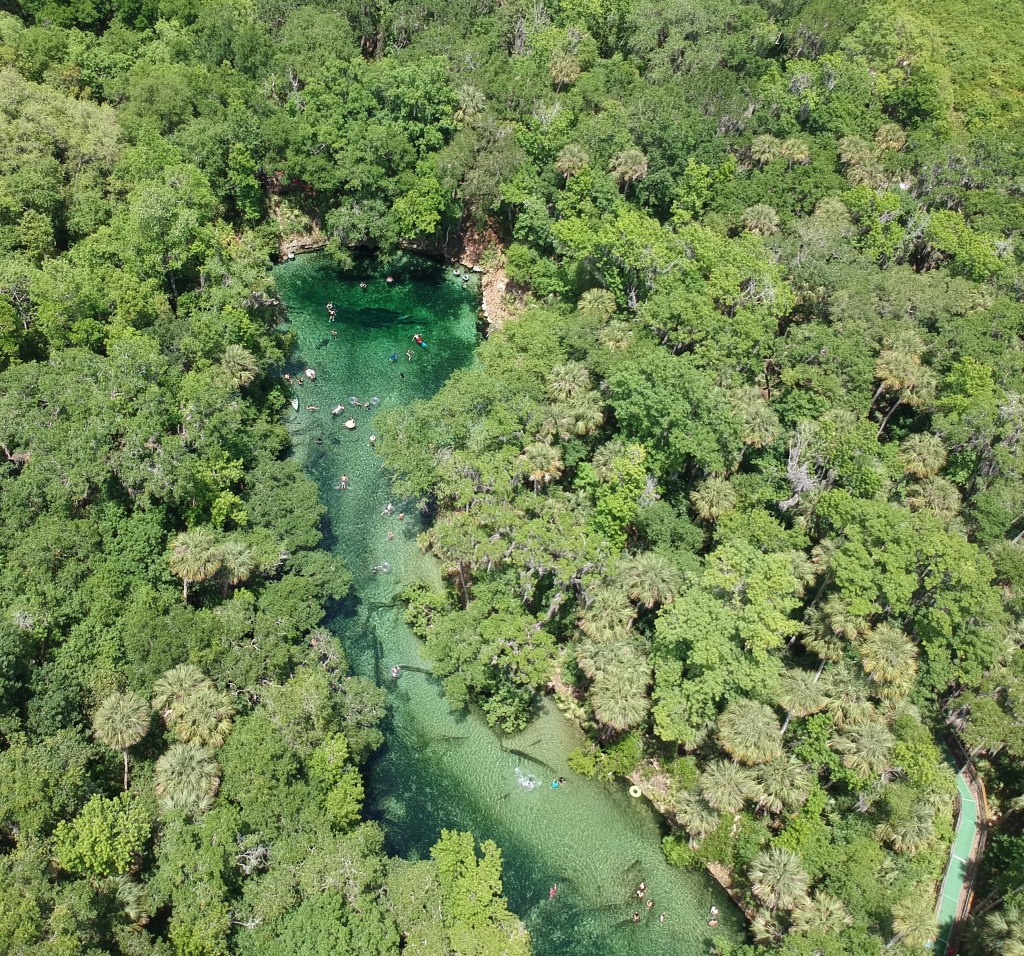
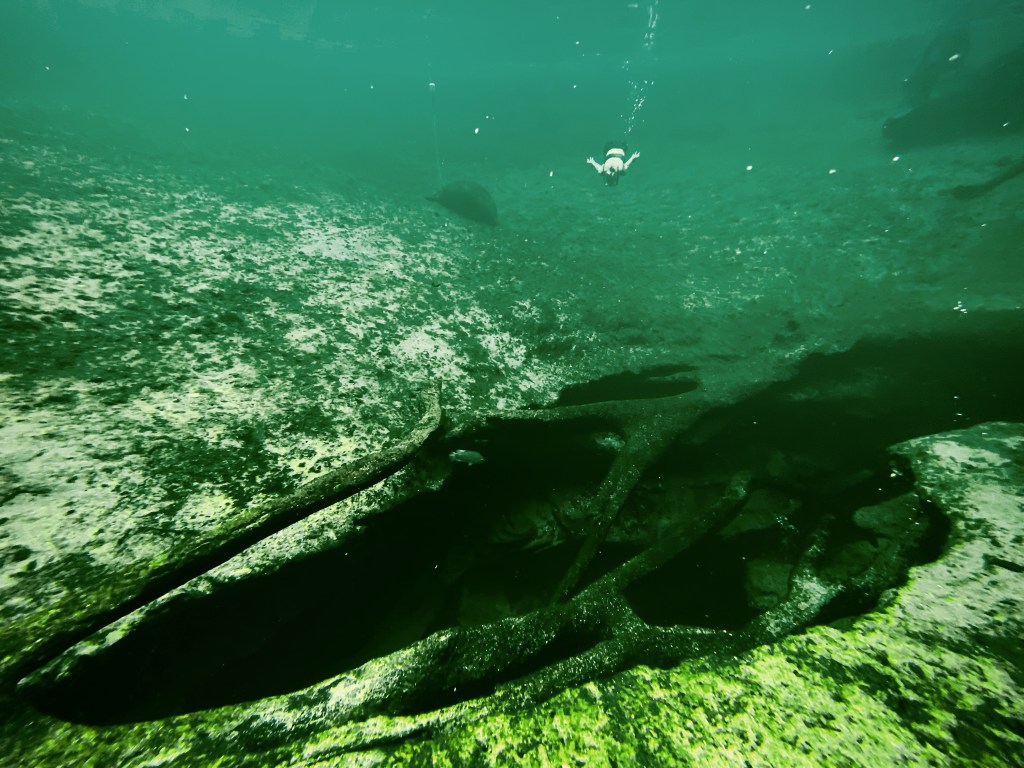
Blue Spring is an aquatic cave connecting the Florida aquifer with the surface, with an old fallen tree guarding the entrance. The cave has been mapped down 125 feet into the earth, and an average of 87 million gallons of fresh water flows out from the spring and into the St. John’s river, daily.
In the winter months, a first magnitude spring like this is refuge to hundreds of Florida’s beloved, threatened sea cows. Manatees from the St John’s river travel to the spring to bask in the steady 72-degree water. Cold, but warmer than the surrounding river or ocean from November to April. Four hundred and eighty-five individuals were observed at Blue Spring in the 2018 winter season, making this a very important area of refuge for the species.
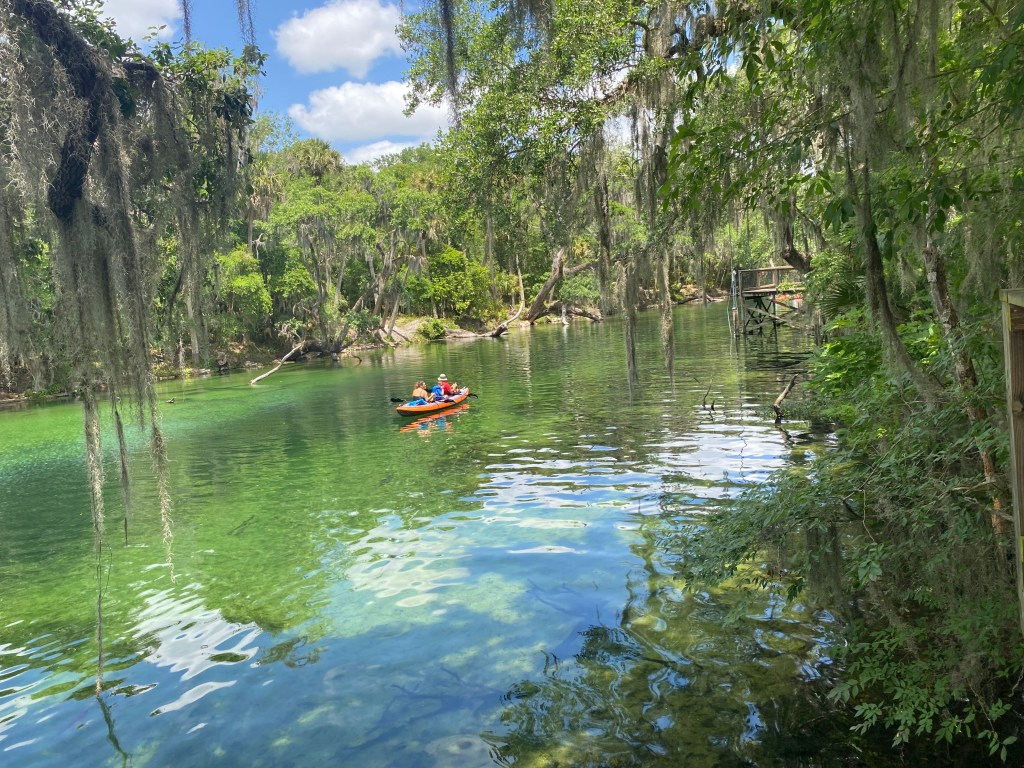
Plantaina is a young manatee living thanks to the work of Disney’s The Seas with Nemo and Friends at EPCOT and manatee rescue group volunteers. At Blue Spring State Park, a volunteer on a kayak tasked with watching and protecting Plantaina told us her story. Rescued in Dade County as an abandoned baby, Plantaina was first released in an area of the Everglades. She began losing weight rapidly and was brought back to rehabilitation, this time at Disney. This release to Blue Spring in February 2021 is thus the second attempt to reintroduce her to the wild.
Plantaina is a social butterfly, and prefers to be near humans. They track her and monitor her movement and weight. In her second year at the state park, she still needs to spend more time in the river where there is food for her, but overall she is doing pretty well.
It is great to know there are teams of volunteers working to keep Plantaina and others like her safe, despite the challenges facing the species. Read more about the current state of the manatee in Florida here.
It should be noted that the Blue Spring swimming area is closed from November to April to allow the manatees peaceful refuge. The state park is also a popular place for humans: 532,549 visitors in 2011, which is an average of over 1,450 people a day for 365 days.


Thursby House
History is imagination. People like history – books, movies, stories – because of the imagination it draws out. You put yourself there, in the moment, in the era, and imagine what you must have felt, how you would have reacted, what you would have done. The best history tales end in the response: “I can’t even imagine”.
An old white house is only semi-interesting to look at. It is its history that fires up the imagination and earns your intrigue.
Lewis and Mary-Ann Thursby left Brooklyn, NY with their infant daughter in 1856 and bought 133 acres surrounding Blue Spring for 400 dollars. Included was a rustic log cabin along the spring run. These were not the Vanderbilt’s building a mansion in the North Carolina mountains; these were lower-class people setting out for a new life in a new land. After years in the cabin, the family began construction on the larger Thursby home in 1872.
They connected to the outside world via a steamboat stop at the end of the spring run. The closest town was a mule-ride away, Enterprise Florida. The two had 9 children together, 3 of which died in infancy. The first son, Lewis Jr., died by rattlesnake bite while playing under the house.
The Thursby’s made the most of opportunities around them at the time, eventually being described as middle class. They rented out row boats, became local postmasters, and acquired more land through cheap U.S. government land grants. As the U.S. government pushed the Seminole tribe down to the swampy everglades, the family gathered more and more property.
For me, I imagine how beautiful 133 acres around the untouched spring must have been. Teaming with wildlife. There must have been a sense of freedom and adventure. You must also imagine how tough life must have been – the heat of Florida, the cooking, the bugs, the wildlife… The day-to-day realities of living in such a place in such a time. It would have been uniquely beautiful and immensely challenging.

Behind the Scenes
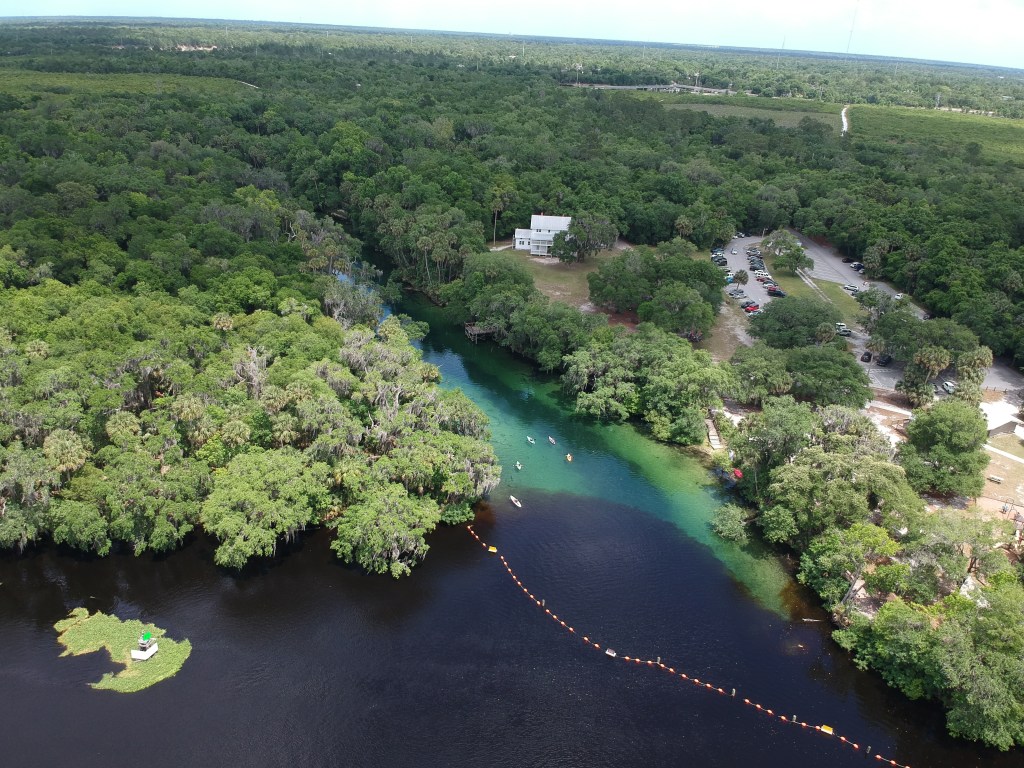
The springs trips are about the journey. The drone pictures are beautiful and show the scale of the streams and water system, but the real fun is capturing them. The view during the entire flight is beautiful, and the flight is always perilous. Launching from the top of a cooler on a kayak is not ideal, and the drone has to travel quite a ways to get shots of the spring head.
Sending your $500 toy well out of eyesite over some remote woods is always nerve racking. The “turn it around turn it around” suggestions by your kayak partner do not help, knowing that the “I told you so” would be coming later if things go to hell. Your heart drops with the screen blips or, the worst, when you lose signal with the craft.
Flying about 1/3rd of a mile to the spring head offered some great views up the spring run and only took a few minutes. But we did lose signal right as the spring head came into view – fortunately, the drone behaved as it should and starting flying back to the home point until signal was regained. My heart definitely skipped a few beats though… I have lost one out on a river before…
Landing back on the same small cooler in the kayak proved to be impossible without dropping it into the water or into my kayak partner’s hair. I ended up just grabbing it from the bottom mid-flight and pulling the battery out to shut it off.
It was an exciting drone flight.
A visit to a massive first magnitude spring is fleeting. There is anticipation, preparation, and it comes down to a few minutes at the actual spring. You travel there, kick off your sandals at the dock, work up the courage to jump in… then you have a few minutes, with the aquifer slowly pushing you away, to view the underwater formation and wildlife you traveled to see.
The fleetingness is part of the joy.
 First Magnitude Florida
Leave a comment